

At a waste treatment facility, odor episodes are often brief, multi-compound, and highly dependent on meteorological conditions. By combining a network of multi-parameter sensors with short measurement intervals (as low as 10 seconds), multivariate analysis (signatures, clustering, anomaly detection), and real-time dispersion modeling, operators can move from a reactive ‘complaint/observation’ approach to a proactive management strategy: source attribution, downwind impact forecasting, operational alerts within seconds, automation (ON/OFF, 4–20 mA, API), and traceability reporting for environmental compliance requirements (ICPE/IED, olfactory metrics compliant with reference standards).
Why couple dispersion modeling with multivariate analysis?
Multi-source and multi-compound: the typical case of waste treatment sites
Sorting centers, energy recovery units, landfills, organic recovery platforms, and transfer stations concentrate multiple sources of emissions: waste degassing, fermentation, handling operations, air treatment (capture, biofiltration), combustion, internal traffic, and utilities (HVAC, boilers, flares, compressors).
In this context, limiting monitoring to a single spot measurement or a single “indicator” gas (e.g., H₂S or NH₃) is rarely sufficient. Odor nuisances often result from a mixture of chemical families (sulfur- and nitrogen-containing compounds, VOCs, aldehydes, mercaptans, volatile fatty acids), whose expression and perception vary depending on operational activities and meteorological conditions.
From reactive measurement to a control loop
The coupling of multivariate analysis (signature recognition, event clustering, probable source attribution) with real-time dispersion modeling (plume projection based on meteorological conditions) serves an operational purpose: to detect early, locate, anticipate downwind impact, and then trigger traceable corrective actions (containment, adjustment of capture systems, activation of air treatment, operational instructions).
Field limitations of conventional approaches
Single-parameter measurements: weakened source attribution
Traditional systems often rely on targeted monitoring (H₂S, NH₃, CH₄…) or on periodic campaigns. At a waste site, this approach quickly loses effectiveness when:
- a perceived odor results from co-occurrences (sulfur + nitrogen + VOCs) at low concentrations but with high odor potency;
- emissions are intermittent (short peaks during unloading, door openings, turning operations, or capture system malfunctions);
- multiple sources are active simultaneously, making the “source → impact” link uncertain without meteorological context and multivariate analysis.
Lag between perception, measurements, and dispersion
An odor episode may last only a few minutes. With a 15-minute measurement interval (or a weekly campaign), the signal can be smoothed out or missed entirely. The impact depends heavily on atmospheric stability, wind direction/speed, humidity, and temperature, which influence emission, transport, and perception.
Without a real-time dispersion model, it is difficult to reliably connect: the measured event, the probable source area, the downwind plume, and the potentially affected zones.
Traceability and regulatory framework
Affected sites are generally regulated under classified installations legislation: ICPE regulations focus on preventing “inconveniences to neighborhood amenities” and protecting the environment (French Environmental Code – Article L511-1).
At the European level, Directive 2010/75/EU (IED) structures requirements for integrated pollution prevention and reduction, based in part on Best Available Techniques (BAT).
For odors, quantification in odor units follows NF EN 13725 (dynamic olfactometry), which defines a standardized method to determine the odor concentration of a gas sample. Additionally, field methods for characterizing environmental odor presence may follow NF EN 16841-2 (plume method).
Real-time architecture: sensors, data, and dispersion
Short-interval multipoint network: capturing transients
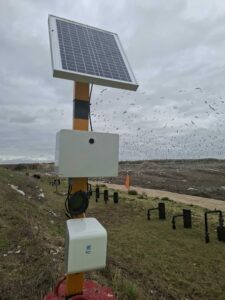
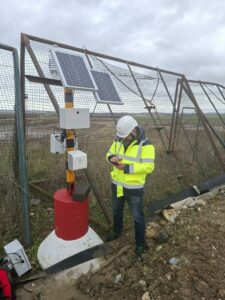
A robust strategy combines sensors placed:
- Near sources (process areas, structures, transfer points, air treatment units);
- At the perimeter (site boundaries, downwind impact points);
- Indoors if needed (operator stations, sorting cabins, transfer zones).
A fine measurement step (up to 10 seconds) allows detection of short-lived events: dock openings, batch changes, air treatment drift, transient leaks, or capture system incidents.
Depending on the context, the monitored parameters may include:
- Indicator gases (H₂S, NH₃, CH₄, CO, NO/NO₂…);
- VOCs (TVOC/PID as needed);
- Particles (PM10, PM2.5, PM1);
- Olfactory fingerprint signals (MOS/MOX sensors);
- Local meteorology (wind, temperature, humidity, pressure) — essential for interpretation and modeling.
Multivariate analysis: signatures, clustering, anomalies
The goal is not to multiply curves, but to transform multi-sensor streams into qualified events. A typical processing chain includes:
- Time alignment and quality control (outliers, missing data);
- Normalization and drift management (critical for MOS/MOX sensors sensitive to ambient conditions);
- Feature extraction (gradients, peak durations, co-occurrences, ratios, stability indicators);
- Statistical/AI models: anomaly detection, supervised classification if ground truth exists, or clustering otherwise;
- Signature identification (reusable for alerting and reporting).
Expected outcome: move from “threshold exceedance” to “Event A compatible with a known signature and conditions.”
Real-time dispersion: projecting downwind impact
Dispersion modeling links:
- an emission or event indicator,
- instantaneous meteorology,
- an estimate of plume spread.
It serves two main purposes:
- Short-term anticipation: identify sensitive areas likely to be downwind if the emission persists;
- Post-event explanation: reconstruct an episode by linking signature, operational sequence, and wind conditions.
Robustness increases when dispersion is guided by source attribution from multivariate analysis: weighted sources are projected rather than a single “global site” representation.
Alerts and automation: closing the loop
Contextualized alert rules
A useful alert combines multiple criteria: detected signature, persistence, intensity, spatial validation (multiple downwind sensors), and meteorological conditions (wind toward sensitive area). Examples:
- Odor alert: signature X detected + wind toward sensitive zone + persistence > N minutes;
- Gas alert: threshold exceedance + multi-sensor co-occurrence;
- Perimeter alert: simultaneous gradient across multiple points (spatial consistency).
Industrial interfaces and proof of action
Integration via ON/OFF outputs, 4–20 mA, or API allows triggering a response (spraying, ventilation adjustment, confinement, capture adjustment, operational instructions) and timestamping the action. Spot sampling can also be performed to cross-validate alerts, enhancing the reliability of the measurements. This traceability contributes to a complete chain of evidence: measurement? weather context? source attribution? action? result.
Opening: toward more integrated management
Ultimately, integrating operational data (process states, schedules, openings, air treatment operation) with performance indicators can further strengthen source attribution and accelerate continuous improvement, while maintaining a factual and auditable approach.
ELLONA solutions available
Sensors, platforms, and on-site diagnostics
To implement this architecture, ELLONA offers complementary modules that can be configured according to the objective (source, perimeter, indoor, diagnostics):
- EllonaSoft: centralizes data, performs analysis, generates alerts, supports operational use and reporting, with API integration and operational interfacing capabilities.
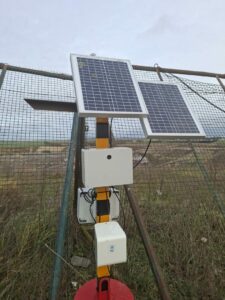
- WT1 Pro: multiparameter outdoor monitoring (configurable) to instrument source zones and/or impact areas, particularly for channeled emissions.
- WT1 Lite: outdoor measurement point suited for perimeter monitoring and characterization of downwind gradients.
- POD2: indoor monitoring (IAQ) for operator areas and sensitive rooms, useful for correlating indoor/outdoor events.
- Dustkair: portable device for particle diagnostics in dusty zones (sorting, handling, transfer).
Conclusion: measure, attribute, act
Concrete benefits for operations and compliance
At a waste treatment facility, the value of a monitoring system goes beyond simply measuring. The combination of multiparameter sensors, multivariate analysis, and real-time dispersion modeling enables operators to qualify events, attribute probable sources, anticipate downwind impacts, and reduce response time, while also enhancing traceability in accordance with ICPE/IED regulations and reporting requirements.