
Why is calibration essential?
Calibrating air quality sensors is not just a technical detail—it is the foundation of reliable environmental measurements, especially in IoT environmental monitoring systems, where data are exploited at large scale and over the long term.
Without rigorous calibration:
- Data are inaccurate and potentially misleading.
- Measurements are not comparable across sites, sensors, or with regulatory references.
- Strategic decisions based on these measurements (pollution alerts, environmental policies, industrial management, odor nuisance management) can be costly or even harmful to health and the environment.
In this context, calibration is a prerequisite for the Factory Acceptance Tests (FAT) and Site Acceptance Tests (SAT) of ELLONA IoT devices, ensuring that each instrument is compliant before and after deployment in the field.
Key calibration objectives:
- Accuracy: Ensure measured values precisely reflect the actual concentration of pollutants (gases, particles, odors).
- Linearity: Guarantee a proportional response across the entire measurement range, essential for regulatory and comparative analyses.
- Transferability: Enable reliable comparison of data across different sites, instruments, and measurement campaigns.
- Robustness: Maintain sensor reliability under variable environmental conditions and over time (temperature, humidity, drift, complex pollution).
In summary: Accurate measurements require uncompromising calibration. Calibrating ensures confidence in every single data point!
Calibration at the heart of reliability
At ELLONA, calibration is not optional – it is a scientific and industrial requirement, integrated from the IoT FAT (Factory Acceptance Tests) phase.
Each sensor installed on the WT1 electronic board is individually calibrated to ensure:
- Accuracy: Measurements precisely reflect the actual pollutant concentrations.
- Linearity: Values remain proportional to real concentrations across the entire measurement range.
- Transferability: Data are comparable across sites and compliant with international standards.
- Robustness: Reliability is maintained under extreme environmental conditions and over the long term.
To structure this process, ELLONA has developed two Standard Operating Procedures (SOPs), fully aligned with the FAT/SAT requirements for IoT systems:
- Factory SOP (FAT): Ensures initial calibration, multi-point validation, initial drift verification, and functional compliance before delivery.
- Field SOP (SAT): Describes re-calibration, drift compensation, and adaptation to real-world conditions after on-site installation. Re-calibration must be performed regularly, depending on the sensor type and environmental conditions.
Our WT1 devices have been recognized for their excellence in independent evaluations:
- Airlab Challenge by Airparif 2021: Best multi-pollutant sensor
- Airlab Challenge by Airparif 2023: Best NO₂ sensor
These results confirm that ELLONA’s methodology – combining factory calibration (FAT), embedded algorithms, and on-site re-calibration (SAT) – delivers reliable, precise, and traceable measurements from the moment of deployment.
Selection of sensors deployed on our electronic boards
- Each sensor (electrochemical, particulate, or odor) is individually tested before being integrated onto an electronic board.
- Only sensors meeting strict criteria for accuracy, linearity, repeatability, and stability are selected.
- Every ELLONA instrument follows FAT protocols specific to environmental IoT technologies:
- Electrochemical gas FAT: zero, span, linearity, cross-sensitivities
- Particulate FAT: repeatability, stability, inter-sensor consistency
- Odor FAT: repeatability of signatures, drift, response time
- ELLONA exclusively selects sensors from reputable manufacturers, recognized for performance and long-term stability.
- Non-compliant electronic boards and sensors are systematically rejected.
Advantage:
This approach enables precise, individualized calibration, ensuring full scientific control from the very design stage of the IoT device.
Laboratory characterization and multi-point factory calibration (FAT)
Each sensor undergoes a full Factory Acceptance Test (FAT) campaign in the laboratory, covering conditions close to real-world environments.
Sensors are tested under extreme environmental conditions (temperature, humidity, pressure, cross-interfering gases) to anticipate behavior in actual field conditions (industrial zones, hot or cold climates, complex atmospheres).
The WT1 sensor chambers include temperature and relative humidity sensors, enabling dynamic drift compensation.
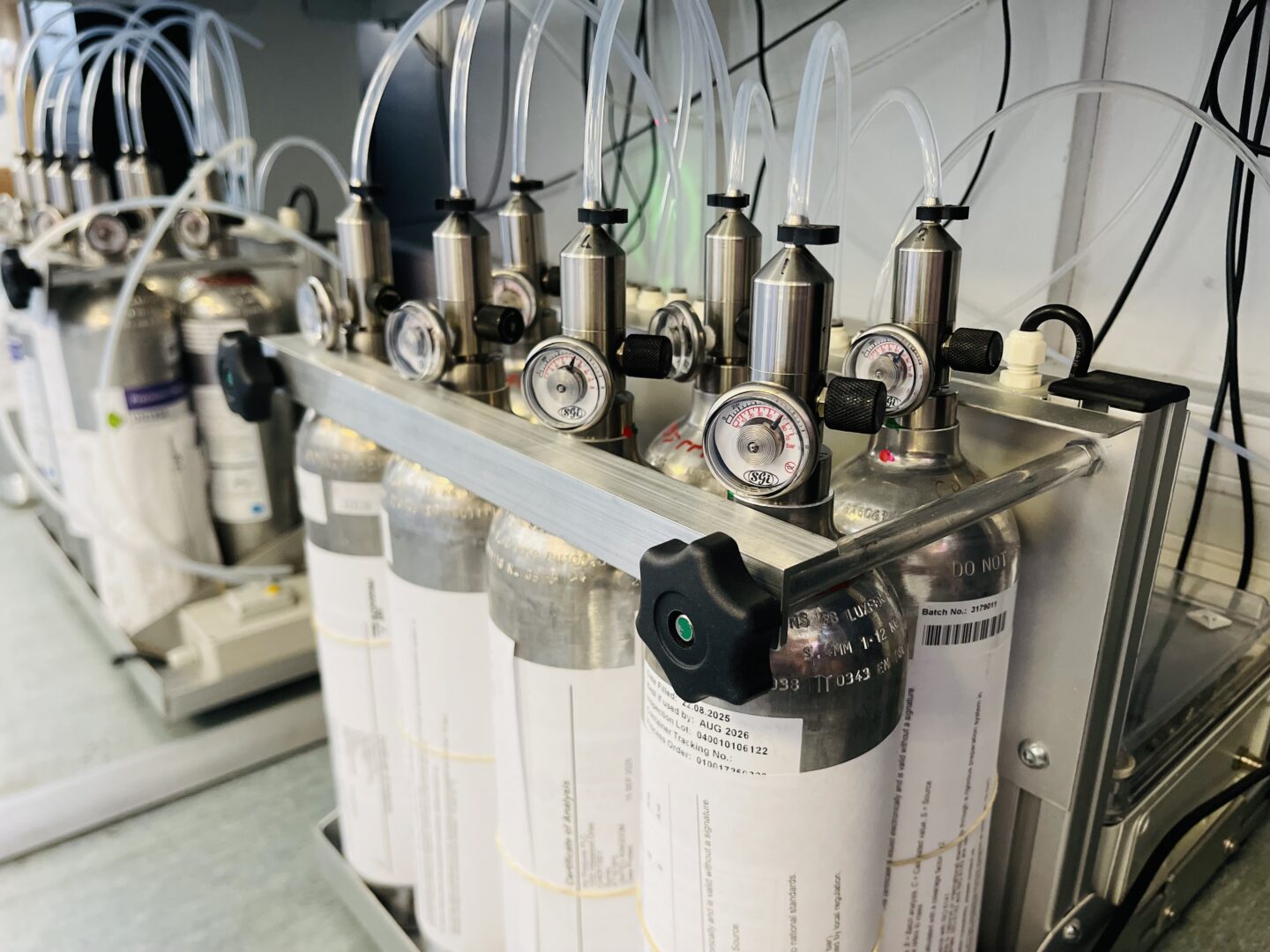
Multiple known concentrations are generated using a high-precision dilution bench (MFC) to allow:
- Multi-point calibration of electrochemical gas sensors
- Functional validation of odor sensors (MOX / electronic noses)
Each response curve is established sensor by sensor, then WT1 unit by WT1 unit.
Calibration coefficients are recorded, secured, and encrypted within the WT1 system.
As a result, every WT1 station is delivered with its factory calibration certificate, validated as part of the FAT.
Benefits:
- Stable, accurate, and linear measurements from the moment of deployment
- High environmental robustness
- Maximum data transferability between stations and sites
On-site calibration and corrections (SAT)
After multi-point factory calibration (FAT), adaptation to real deployment conditions is essential. Actual environments (air chemical composition, climate, local sources, interferences) cannot be fully reproduced in the laboratory.
ELLONA has therefore developed three complementary methods, which can be used independently or combined, to ensure metrological continuity, robustness, and data transferability throughout the WT1 station lifecycle.
Co-location with a reference station – On-site recalibration (SAT – Reference Method)
Principle:
Co-location involves temporarily installing an ELLONA WT1 station in the immediate vicinity of a regulatory or accredited reference station, measuring the same pollutants under strictly identical conditions.
Both systems collect data simultaneously over a representative period (typically 7 to 30 days), covering various pollution regimes (background, peaks, and meteorological variations).
Parameters Adjusted:
- Electrochemical sensor sensitivity (gain)
- Actual linearity across the observed concentration range
- Systematic bias correction
- Adjustment of embedded algorithmic models (regression, cross-compensation)
Sensor-specific details:
- Electrochemical gases: full recalibration (zero + span + slope)
- Particulates: adjustment of environmental correction factors (humidity, seasonal variations)
Advantages:
- Scientifically robust and widely recognized method
- Direct alignment with regulatory standards
- Excellent data transferability
Constraints:
- Logistical mobilization required
- Temporary unavailability of the station
- Reference stations may be limited in the pollutants measured (e.g., H₂S, NH₃, odors)
Typical use cases:
- Launch of sensitive projects
- Regulatory audits
- Industrial sites with strict constraints
- Initial validation of new IoT networks
However, this method requires temporary instrument removal, results in a data gap of several days or weeks, and some reference stations do not measure gases such as H₂S or NH₃.
Calibration with certified gases – CalBox (On-site ALPHA 2 Type calibration – Metrological traceability)
The ELLONA CalBox is a portable calibration system designed exclusively for electrochemical sensors. It allows controlled injection of ISO/NIST-certified standard gases directly on-site, without dismantling the WT1 station.
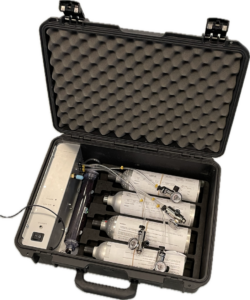
It reproduces, at the field scale, the factory calibration conditions performed during FAT, ensuring metrological traceability of measurements for electrochemical sensors.
Technical capabilities:
- High-precision dual-channel flow regulator to generate a wide range of concentrations and flow rates, suitable for single or multiple sensors.
- Portable multi-gas dilution bench, capable of analyzing up to four gases or more, using swappable gas cylinders.
- Programmable concentration generation
- Simultaneous calibration of multiple electrochemical sensors with the same device, increasing versatility and reliability of on-site calibrations.
- Control via ELLONASOFT (PC) for smooth management and automatic updating of sensor parameters.
Parameters adjusted for electrochemical sensors:
- Zero and span (sensitivity verification and adjustment)
- Repeatability verification
- Response time validation
- Automatic update of calibration coefficients in the WT1
Advantages:
- No dismantling or factory return required
- Near-continuous service
- Fast, precise, and reproducible method
- Perfectly suited for industrial environments
Typical use cases:
- Scheduled preventive maintenance
- Remote or hard-to-access sites
- Harsh environments (H₂S, solvents, high humidity)
- Large IoT networks requiring standardized interventions
Remote drift compensation via advanced data processing – BETA corrections (Operational Continuity)
Principle:
When immediate on-site recalibration is not possible, ELLONA applies advanced algorithmic corrections based on historical data analysis, environmental trends, and typical sensor behavior.
Note:
These methods do not replace calibration with an external reference, but they help maintain data consistency between two recalibration operations. These corrections do not adjust sensitivity, only the baseline.
BETA 1 – Manual Baseline Correction:
- Zero-point adjustment based on historical data
- Triggered by detection of slow drift
- Validated by an ELLONA expert
BETA 2 – Automatic Baseline Correction (ABC):
- Embedded algorithm automatically detecting background noise periods
- Continuous correction without human intervention
BETA 3 – Certified Particulate Correction (MCERTS):
- Application of correction factors from MCERTS certification
- Exclusive use of certified sensors
- Takes into account humidity and particle size
Remote management and supervision via ELLONASOFT
Thanks to the ELLONASOFT platform and the Customer Success team, the entire process of sensor calibration, correction, and monitoring can be performed remotely, without on-site intervention.
Key Features:
- Real-time monitoring: sensor status, anomalies, battery level, performance
- Comprehensive calibration management: remote calibration, baseline corrections, automatic updates
- Complete history: all operations are recorded for audits, traceability, and regulatory compliance
Impact:
- Ensures full traceability and reliable real-time data
- Provides maximum security, flexibility, and performance while minimizing field interventions
- Optimizes the robustness, accuracy, and transferability of WT1 measurements, even in complex and varied environments
ELLONA key strengths summary
ELLONA offers a comprehensive and rigorous approach to air quality sensor calibration, ensuring measurements that are accurate, linear, transferable, and robust.
- Sensor selection: Only the highest-performing sensors on the market, compliant with international FAT standards, are integrated.
- Laboratory and factory calibration: Tests under extreme conditions, online drift compensation, and response curves established using a high-precision dilution bench.
- On-site calibration and recalibration: Co-location with reference stations, calibration with certified gases via CalBox, and drift corrections when no reference is available.
- Remote supervision and maintenance: Real-time monitoring, full management of calibrations and corrections via ELLONA Cloud.
- Proven performance: Best multi-pollutant sensor at Airparif 2021; Best NO₂ sensor at Airparif 2023.
Conclusion
Accurate measurements require uncompromising calibration. Calibrating ensures confidence in every data point.
ELLONA adopts a scientific, rigorous, and fully traceable approach to air quality sensor calibration. From selecting the highest-performing sensors to remote supervision via ELLONA Cloud, every step is designed to deliver measurements that are precise, linear, reliable, and robust, even in the most demanding environments.